
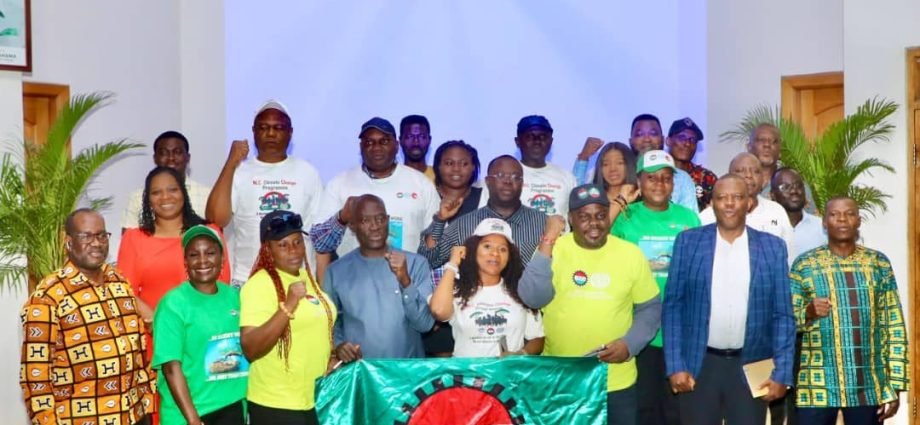
A team of trade union leaders from Trades Union Congress (TUC) Ghana, and Nigeria Labour Congress (NLC) have paid a visit to the Forestry Commission (FC) as part of a climate change learning and exchange tour.
The visit sought to apprise the delegation with knowledge about Climate Change governance systems and frameworks in Ghana; observe the progress, achievements and challenges over the years. It also aimed to provide an opportunity for the visitors to exchange and discover innovative, solution-oriented and rights-based approaches to new and emerging contexts; explore partnerships and seek opportunities to build broader alliances to sustain, upscale and amplify actions and impact.
The delegation was
warmly received by Mr. Charles Sarpong Duah, Manager, Monitoring and Evaluation (M&E), and Budgeting; Jennifer Stevens, Benefit Sharing Officer; Diana Smith, Monitoring, Reporting and Verification (MRV) Officer; Nora Koufie Project officer, FC/Tullow;Osei Kwadwo Agyemang Nyame, Governance Officer, FC/Tullow, and other staff of the Climate Change Directorate (CCD).
Mr. Charles Sarpong Duah, delivered a detailed presentation on the Climate Change Directorate’s mandate and activities, focusing on Ghana’s forest-based climate strategies under the Paris Agreement and Reducing Emissions from Deforestation and Forest Degradation (REDD+) initiative. Key programs such as the Ghana Cocoa Forest REDD+ Programme (GCFRP), Shea Landscape Emission Reduction Program (GSLERP), and FC/Tullow REDD+ aim to cut emissions, enhance carbon stocks, and improve livelihoods, contributing to Ghana’s goal of reducing 64 million tonnes of carbon dioxide equivalent by 2030.
The presentation also highlighted on partnerships with organisations like the World Bank, the United Nations, and LEAF Coalition, along with achievements including emission reductions, infrastructure development, benefit-sharing, and tree planting. It addressed in detail, mechanisms like MRV, grievance redress, and safeguards to ensure transparency, while noting challenges such as illegal mining, bushfires, and logistical constraints. Future priorities discussed included sustained funding, stakeholder engagement, capacity building, and lessons on inclusive governance, community involvement and strategic leadership.
An engaging discussion followed, during which the delegation posed questions to deepen their understanding of the presentation and the broader function of FC in Ghana.
The visit concluded with a group photo to commemorate the occasion and a general consensus of Ghana’s intentionality in matters of climate action from the visiting team


