
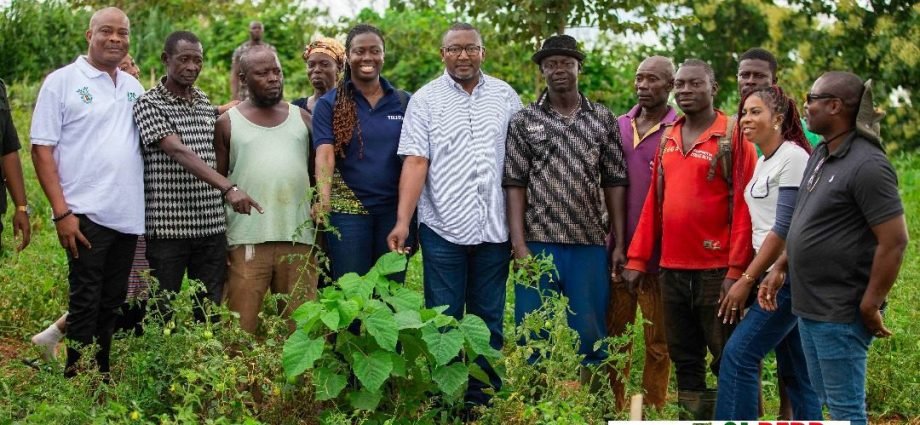
In an era where Ghana’s climate teeters at a tipping point, the Forestry Commission (FC) and Tullow Ghana have united in a bold, purposeful stride toward sustainability. Through the signing of an Emission Reductions Purchase Agreement (ERPA), this public-private partnership breathes life into Ghana’s REDD+ strategy and the government’s wider reforestation ambitions.
The Project focuses on decarbonising Tullow Ghana’s operations and creating alternative livelihoods for the benefit of local communities in line with Ghana’s REDD+ Strategy. The goal is to offset a remarkable 600,000 tonnes of carbon annually over a 10-year period spanning 2025 to 2035.
Rooted in the transitional belt of Ghana, Bono and Bono East Regions, this transformative Project seeks to reweave the green fabric of degraded forest lands. A combined 1,000 hectares of forest cover (400ha in Bono and 600ha in Bono East) is earmarked for restoration in its maiden year, 2025. The reforestation efforts will harness two powerful ecological interventions: the Modified Taungya System (MTS), where farmers cultivate timber trees side by side with foodstuffs, and the Enrichment Planting Module, aimed at reviving partially degraded forest reserves with native and economic tree species.
Yet, this venture is more than tree planting; it is a story of communities, resilience, and commitment. To ensure the fidelity of implementation, the leadership of Tullow Ghana and the FC embarked on a two-day field mission to these regions in July 2025, connecting policy with people and intention with action.
The Tullow and FC delegation was warmly received in Sunyani by Mr. Godfred Mawutor Quarshigah, the Bono Regional Manager. In his opening remarks, Mr. Thomas Yaw Gyambrah, Manager, Climate Change, FC, outlined the day’s purpose: visits to the MTS site in Tain II Forest Reserve and the Enrichment Planting site in Asukese Forest Reserve. The anticipation hanged in the air like morning mist.
With a voice that echoed both command and care, Mr. Quarshigah declared, “We are on course. Bono will not disappoint you.” This he made in his response.
Mr. Jean-Medard Madama, Managing Director of Tullow Ghana, emphasised the Company’s deep commitment, “We have pledged to the world to be net zero by 2030. This partnership with FC is key to achieving that goal.”
Mrs. Valerie Fumey-Nassah, Director of Operations, Plantations, Forest Services Division (FSD), standing in for Dr. Hugh C.A. Brown, Acting Chief Executive, FC, commended Tullow’s vision. “This partnership,” she said, “is a win-win for both sides. The MTS model of plantation has a benefit sharing plan where 40% of the proceeds from the sale of the timber goes to the farmers, with 5% going to the community and 15% to traditional landowners with the remaining going to the government. It’s inclusive, impactful, and inspiring.”, she concluded.
At the Tain II Forest Reserve, farmers stood like sentinels among seedlings, boots planted firmly in the earth, and pride radiating from their expressions. Mr. Kofi Adu Gyamfi, Sunyani Forest District Manager, before engaging the farmers, explained that the indigenous trees, Ofram, Cedrella, and Gmelina to mention a few, were carefully selected for the site to restore the canopy destroyed by fire, illegal logging, and grazing.
Mr. Madama, addressing the farmers, voiced his admiration: “You are the guardians of these trees. I count on you to make sure they all stand tall when I return next year.”
The farmers responded not just with words but with wisdom, as evidenced in the response from Mr. Stephen Oduro, National Chairman of the Vegetable Farmers Association, who spoke with clarity: “We didn’t know trees clean the air until this project taught us.” Another voice, Chiraa Matilda, a tomato farmer, added, “The climate is changing. Growing trees is now survival.”
A ceremonial tree planting was done at Tain II Forest Reserve.
Later in the Asukese Forest Reserve, Compartment 78, the team inspected enrichment planting efforts. Mr. Allan George Lassey, Senior Government Relations Advisor at Tullow, sought clarity on monitoring mechanisms in dense forest conditions. FC experts assured him that planting follows a scientifically mapped design, marked by GPS and ecological principles, allowing for maximum sunlight on the strips and ensuring transparent tracking for long-term success.
The delegation’s next stop was at Peninamisa, a farming settlement in Kintampo and a proud beneficiary of MTS. There, in the Bosomoa Forest Reserve, farmers gathered like a harvest festival, their faces alight with optimism.
Welcoming the team on behalf of the Chief of Peninamisa, Nana Opusu Adwuma Dadie II, a farmer, Mr. Kofi Adu conveyed the community’s appreciation to the FC/Tullow team for coming from Accra to assess the work they are doing. Mrs. Valerie Fumey-Nassah, moved by their dedication, reminded them of their shared responsibility and advised the farmers saying, “Record your harvest profits, it helps us measure the impact and ensures transparency,”
Mr. Madama reiterated the purpose behind Tullow’s involvement: “We cannot reduce all emissions at source, but this Project helps us abate what remains, and it must also benefit the community.”
The voices of the land echoed in return. Mr. Adu declared, “Paninamisa will benefit most. We are committed.” Nana Yaw Fori, representing the chief of the community, respectfully suggested the use of stumps instead of potted seedlings for planting. “Potted seedlings struggle without rain. The stump variety is more resilient; may we consider a switch?” This honest feedback exemplified the Project’s participatory spirit. The visit was climaxed with a commemorative tree planting exercise in the Reserve, where all members of the team planted a seedling to symbolise shared goals and mutual respect.
Before the visit to Paninamisa, the delegation visited the Bono East Regional Office, where Mr. David Kwaku Appiagyei, Regional Manager, and his deputy shared updates on the Project. They noted that it is progressing well in the Kintampo and Nkoranza Forest Districts. Though challenges like inadequate logistics persist, the spirit remains undaunted.
The Tullow and FC delegation made a final stop at the Tuobodom Chief’s Palace, where together with Mr. Elikem Eric Kevin Kotoko, Ag. Deputy Chief Executive, FC, paid a courtesy call, cementing the Project’s respect for traditional leadership and cultural custodianship.
The Net Zero Agenda is anchored in communities, driven by science, and sustained by partnership. From Sunyani to Kintampo, from seedlings through saplings, to pristine Forest a legacy of stewardship for generations to come.


