
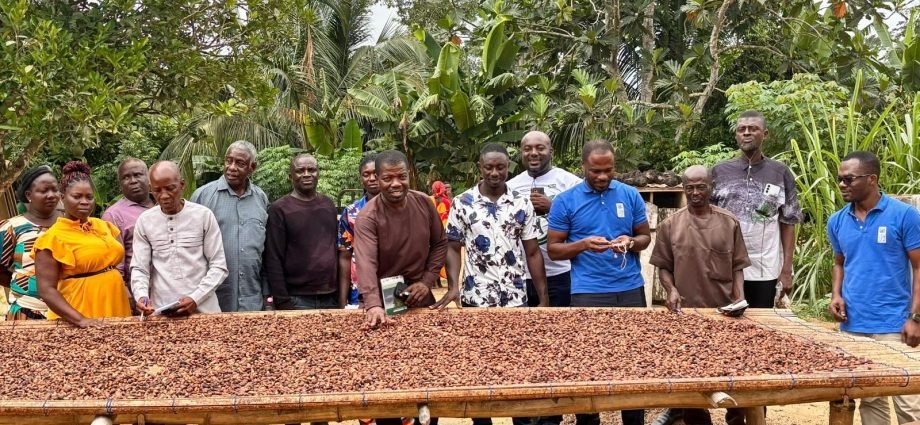
In June and July 2025, the United Nations Development Programme (UNDP), in partnership with the Forestry Commission (FC), facilitated two landmark Hotspot Intervention Area (HIA) Knowledge Exchange Visits under Phase III of the Green Commodities Programme (GCP III).
This was the first formal exchange among all six HIAs established under the Ghana Cocoa Forest REDD+ Programme (GCFRP), setting a new standard for peer learning, cross-landscape collaboration, and stronger governance to advance sustainable cocoa production, forest conservation, and resilient livelihoods.
First Exchange Visit: Learning from Asunafo-Asutifi and Juaboso-Bia HIAs
From 24 to 27 June 2025, delegations from Atewa and Sefwi-Wiawso HIAs visited Asunafo-Asutifi and Juaboso-Bia HIAs, engaging with Forestry Commission officials, community leaders, and cooperative unions.
At Asunafo-Asutifi HIA, participants examined the Modified Taungya System (MTS) at Ayum Forest Reserve, a successful model blending forest restoration with food production, delivering shared benefits to farmers, the Forestry Commission, and local communities. The team also toured the modern CREMA Service Centre at Dadiesoaba, recognized for delivering farmer training, technical support, and promoting sustainable agriculture.
Discussions with the Asunafo-North Cocoa Farmers Cooperative Union highlighted how cooperative partnerships drive gender inclusion, youth participation, and sustainable farming, all key to stronger REDD+ carbon payment performance.
At Juaboso-Bia HIA, participants visited the Bia West Cocoa Cooperative Union’s Cocoa By-Product Processing Factory, an innovative enterprise supported by Mondelez International. This cooperative-led initiative shows how agro-based value addition can boost livelihoods, create jobs, empower women, and enhance sustainability.
At Bia Cocoa Health and Extension Division (CHED), participants learned about promoting climate-smart cocoa and integrated landscape management. They also visited Bia National Park, exploring how community partnerships support conservation and enable alternative livelihoods like ecotourism.
Second Exchange Visit: Insights from Kakum HIA
From 29 June to 1 July 2025, Ahafo Ano HIA executives visited Kakum HIA, engaging with local leaders on governance structures, forest restoration, and the District Assembly’s support through office space and administration. A standout feature was Kakum HIA’s collaboration with four CREMAs and exploration of an emerging CREMA Fund, an innovative financing mechanism to sustain conservation, with strong potential for replication elsewhere. The lessons gained will shape future initiatives, enhance governance, improve carbon payment performance, and help build more sustainable and resilient cocoa-forest landscapes


