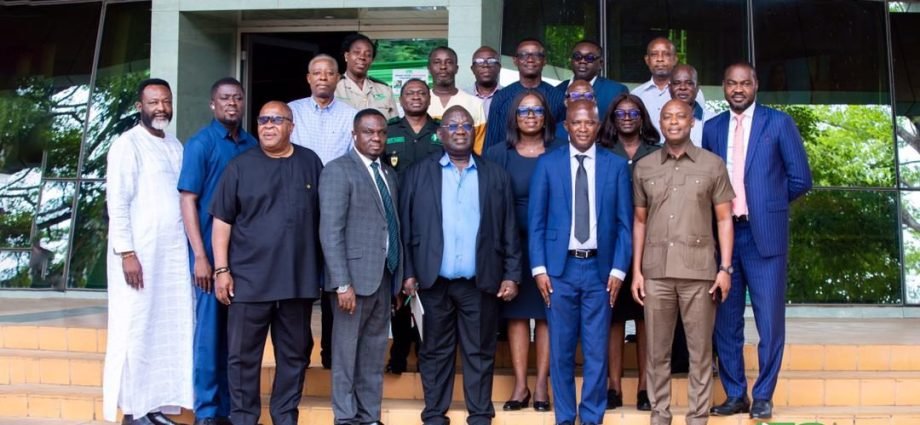
The Ministerial Advisory Board to the Ministry of Lands and Natural Resources (MLNR) has paid a working visit to the Forestry Commission (FC) to familiarise itself with the operations of the Commission and strengthen collaboration between the Ministry and its key implementing agency.
The visiting team, comprising members of the Board, the Secretary, and support staff, was warmly received by the Chairman of the FC Board, Professor Martin Oteng-Ababio, along with the Acting Chief Executive, Dr. Hugh C. A. Brown,his deputies, and members of the Executive Management Team.
In his welcome address, Professor Oteng-Ababio noted that the Forestry Commission is legally mandated to regulate the utilisation, conservation, and management of Ghana’s forest and wildlife resources, in addition to coordinating related policies. He acknowledged that while the Commission carries out its duties with “joy and enthusiasm,” it is not without challenges. He appealed to the Advisory Board for support in addressing these challenges to help the Commission effectively deliver on its mandate.
Responding on behalf of the visiting delegation, Mr. Israel Ackah Esq., Co-Chair of the Advisory Board, explained that the purpose of the visit was to foster meaningful engagement between the Ministry and the agencies under its supervision. He emphasised the Board’s commitment to learning about the Commission’s work and offering its full cooperation to support the government’s broader environmental vision.
Dr. Hugh C.A. Brown, Acting Chief Executive of the Forestry Commission, delivered a comprehensive presentation on the structure, mandate, and operations of the Commission. He explained that the Commission operates under an 11-member Board and is structured into three main divisions and 17 units, employing 4,151 staff of whom 81% are men.
Highlighting key achievements in 2025, Dr. Brown stated that by mid-year, Ghana had welcomed 374,311 ecotourism visitors. In efforts to restore degraded landscapes, 9,707 hectares of plantations had been established. Additionally, nine forest reserves were reclaimed from illegal miners, resulting in the seizure of 190 excavators, 16 vehicles, and the arrest of 345 suspects.
Other major milestones included the launch of the Tree for Life Reforestation Initiative, the issuance of FLEGT timber licenses, making Ghana the first African country to do so and the signing of a landmark REDD+ partnership with Tullow Ghana, projected to offset 600,000 tonnes of carbon emissions annually. The Commission also participated in the 5th World Teak Conference in India and invested in ecotourism infrastructure, including the construction of chalets, canopy walkways, and a bird-watching tower. The year has seen the official launch of the 2025 Closed Season at the Gbele Resource Reserve and the second matriculation of students into the Certificate in Natural Resource Management Programme at the Forestry Commission Training Centre.
Despite these achievements, Dr. Brown acknowledged persistent challenges, including inadequate logistics for field operations, security threats posed by heavily armed illegal miners, insufficient funding for reclamation and reforestation, and lengthy judicial processes for prosecuting forest offenders.
He outlined key priorities for the rest of 2025, including the launch of the Ghana Forest Landscape Restoration Strategy, implementation of the 2024–2028 Strategic Plan, piloting the Domestic Timber Trade Network, and enacting regulations to operationalise the Wildlife Resources Management Act, 2023.
Looking ahead, the Ag. Chief Executive mentioned that the Commission plans to establish operational camps for staff, review the Forestry Commission Act to potentially restructure the agency into a paramilitary institution for more effective enforcement, expand ecotourism through public-private partnerships, and implement payment for ecosystem services to support biodiversity conservation, watershed protection, and climate change mitigation.
The visit concluded with an interactive session where members of the Ministerial Advisory Board posed questions to deepen their insight on the operations and challenges of the FC.


